

“Most mornings I learn more from New Items than I do from all of the traditional papers I read combined.” — Michael Blair, former presiding partner, Debevoise & Plimpton.
1. Plan A:
AI companies are racing to build AIs that are smarter than humans in every way. In AI 2027, we predicted that this would result in either extinction or irreversible concentration of power. Plan A is our positive vision for what should happen instead. In this scenario, humanity delays the development of superintelligence until 2040, makes all AI research public, allows dozens of companies globally to catch up to the frontier, and intentionally enters a regime of mutually assured compute destruction. (Sources: ai-2027.com, ai-2040.com. Both ai-2027 and ai-2040 are worth reading in full.)
2. OpenAI has publicly released its flagship artificial intelligence technology, GPT-5.6 Sol, its most powerful model yet, alongside a new tool to assist with everyday office work. The new release, on Thursday, escalates the battle for A.I. dominance with the rival start-up Anthropic as the technology grows increasingly sophisticated. (Source: nytimes.com)
3. OpenAI and Google are selling their advanced AI models to Chinese tech giants blacklisted by the Pentagon, exposing a gap in Washington’s efforts to slow Beijing’s AI development. The US companies confirmed to the FT that they have been supplying AI services to Singapore-based subsidiaries of Alibaba, Baidu and Tencent, which the US government has accused of working with China’s military. After being contacted by the FT this week, OpenAI said it had last month suspended Alibaba-affiliated users’ access to its API, the software interface that lets developers remotely access AI models, over concerns about illicit use. (Source: ft.com)
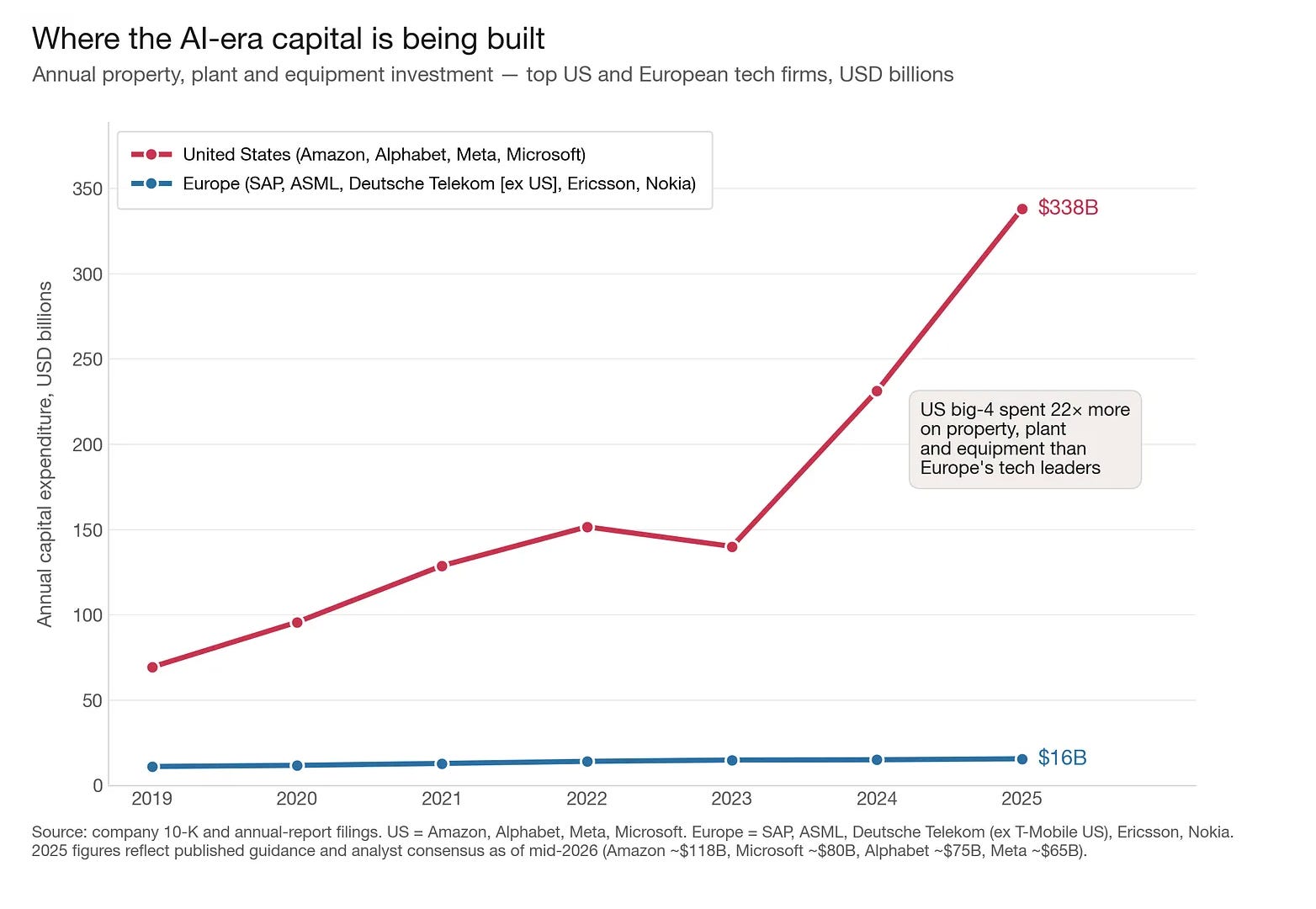
4. Chart of the Day: The U.S., Europe and AI:
(Source: substack.com/@hannolustig)
5. As investors increasingly turn to artificial intelligence for help with everything from stock picking to risk management, JPMorgan Chase & Co. has been testing whether a model can do something more ambitious: allocate money itself. The early results are encouraging. Researchers at the bank built an array of AI-powered investing agents that shift between stocks and bonds depending on changing market conditions. In backtests spanning the past two decades, the best-performing system topped a traditional 60/40 portfolio — 60% in stocks and 40% in bonds — by 0.7 percentage point a year with lower volatility, while also beating JPMorgan’s own rules-based market regime model, according to strategists led by Thomas Salopek. (Source: bloomberg.com. linkedin.com)
