

“It’s the first thing I read every morning.” -- Rob Manfred, MLB Commissioner.
Posted and Upcoming Podcasts: Available now: Josh Tyrangiel on AI and Charlie Cook on the mid-term elections. Later this week: (1) A conversation with Sir Richard Moore, former head of MI6, the British Intelligence Service, and (2) a post-election analysis with a guest-to-be-named-later.
1. These days, the people leading AI labs believe it could transform their industry, the global economy and perhaps the fate of humanity. OpenAI’s chief scientist has called it the only way to remain on the frontier. A co-founder of Anthropic says it “might be the most important technical trend in the world.” And unless you work in AI, you’ve probably never heard of it. It’s a phenomenon known as “recursive self-improvement,” or RSI, which roughly translates to AI building smarter AI. Anthropic refers to it as “closing the loop,” a cycle in which each improvement makes the machines better and faster at improving themselves. (Source: wsj.com)
2. The future coming at you: RSI in one chart.

3. An AI agent using Claude Sonnet 5 autonomously performed gene therapy brain surgery on a mouse, choosing the drug, the brain region, and the coordinates, then driving the stereotaxic arms itself. Dr Gabriel Ocana-Santero (Oxford, co-founder and CEO of Y Combinator-backed Exin Therapeutics) gave the agent 19 gene therapy vectors in a spreadsheet, a motorized surgery rig (custom-built on Arduino) with cameras, and one goal: reduce seizures. The agent worked out what was causing the seizures, then chose a therapy that boosts the brain’s natural ‘calming’ signals, targeted only at the cells that produce them. It worked out exactly where to inject using three research papers, then injected a tiny dose while watching through the camera for bleeding, checking the camera 32 times during the operation. (Sources: lifearchitect.substack.com. More on this here and here.)
4. Scientists can now edit genes in precise locations deep in the brain and body without the use of invasive surgery or implants, thanks to new work from researchers at the Wu Tsai Neurosciences Institute. The team demonstrated their technique, which uses a combination of ultrasound, light-emitting nanoparticles, and photo-controllable gene-editing proteins, by successfully altering genes in mouse brains at selected locations. The work – the latest advance in controlling the ever-expanding universe of CRISPR-family gene editors – was published Sept. 28, 2026, in Cell and led by Wu Tsai Neuro Faculty Scholar Guosong Hong, an associate professor of materials science and engineering at Stanford Engineering, and Michael Lin, a professor of neurobiology and of bioengineering at Stanford Medicine and Stanford Engineering. (Sources: news.stanford.edu, cell.com, neuroscience.stanford.edu)
5. Meet Sabrina Pasterski, the theoretical physicist often dubbed the "Next Einstein" who famously built her own airplane at age 14 and flew it at 16. This video explores how she went from a garage mechanic to a Harvard Ph.D. whose work on Celestial Holography was cited by Stephen Hawking. (Sources: physics.mit.edu, youtube.com. Italics mine.)
6. Iran’s Supreme Leader ordered his top military commanders to prepare for renewed confrontation with the US and Israel and expand Tehran’s options for retaliation, even as his top diplomat signaled progress in diplomatic talks. “Every level and type of threat must be met with an immediate, effective response, without geographical limitations,” Mojtaba Khamenei told the heads of the Islamic Revolutionary Guard Corps, the Army and the General Staff of the Armed Forces, according to a statement Saturday on Telegram. (Sources: bloomberg.com, t.me/rahbar_ir)
7. The Wall Street Journal:
Three American service-members were killed in a July 17 Iranian strike on Muwaffaq Salti Air Base in the Jordanian desert. Satellite imagery shows the nighttime attack damaged at least 19 buildings where troops sleep.
It was one of the deadliest nights of the war for U.S. forces. But it wasn’t the only attack targeting American troops where they live and sleep. That same week, Iran hit multiple housing units at other U.S. military installations across the region.
The July strikes marked an alarming shift in Iran’s tactics and revealed an improvement in the regime’s ability to sequence attacks and hit targets with precision. Iran was taking more direct aim at the buildings that house American troops, according to a Wall Street Journal analysis of satellite data, Iranian military statements and interviews with U.S. officials.
The Journal’s analysis offers the most comprehensive public accounting of the war’s damage to American facilities to date. (Source: wsj.com)
8. Russia is testing exporting grain through the Arctic port of Murmansk, thousands of kilometers from the farms where it is grown, as Ukraine’s drone campaign has all but cut off its traditional route via the Black Sea. A bulk carrier in Murmansk started loading 29,500 tonnes of wheat on Wednesday for a trial shipment to buyers in north Africa, according to the port’s Telegram channel, adapting facilities normally used to handle fertiliser for grain. The extraordinary detour illustrates how the escalating battle for control of the Black Sea has upended trade in Russia, the world’s biggest wheat exporter, and Ukraine, another major supplier, despite relatively strong harvests in both countries. The disruption has driven up costs for overseas buyers even as prices received by Russian and Ukrainian farmers have plunged. (Source: ft.com)
9. China’s economic activity slowed sharply in October, with gauges of manufacturing, services and construction all pointing to a loss of momentum. The official manufacturing purchasing managers index fell to 49.3 in October, down from 50.1 in September, said the National Bureau of Statistics on Saturday. (Source: wsj.com)
10. Tens of thousands of demonstrators converged on India’s capital earlier today in a display of mass resistance to the government of Prime Minister Narendra Modi and recent changes to the voter roll. The event, organized by India’s largest opposition political party, the Indian National Congress, is the latest in a string of large protests to ripple through New Delhi since this summer. The demonstrators have marched under different banners, with separate leaders and demands. But they have all expressed unhappiness with Mr. Modi’s nationalist Bharatiya Janata Party, which has led India since 2014, and its initiative to update India’s voter rolls. (Source: nytimes.com)
11. Hooded rioters looted stores in Frankfurt late on Saturday after tens of thousands of demonstrators took to the streets across Germany's biggest cities to demand better education and lower living costs. The protests followed a wave of Gen Z-led demonstrations across Europe this year. In Serbia, student-led activism helped unseat the country's longtime leader at the ballot box, while protests in France have descended into rioting and looting. The German protests organised by the campaign group “Gen Z regelt” — “Gen Z takes charge” in German — took place in 34 cities including Berlin, Frankfurt and Munich. The group says it opposes compulsory military service and wants greater investment in education as many young Germans struggle with rising costs. In Frankfurt, Germany’s financial hub, at least two stores were looted as protests turned violent, with several more damaged and police trying to get the situation under control, according to a Reuters witness. (Sources: reuters.com, theguardian.com)
12. Cryptocurrency exchange Binance says it has replaced 90% of the amount stolen after a record $6.3 billion hack of its platform by a group the FBI identified as being backed by North Korea. The remaining 10% of tokens are less liquid, meaning they may take longer to buy, the company said in a post on X on Saturday. Co-CEO Richard Teng said separately that the company was “committed to covering the remaining 10%” and that “users will not bear the financial impact of this incident”. (Source: theguardian.com)
13. Sabato’s Crystal Ball:
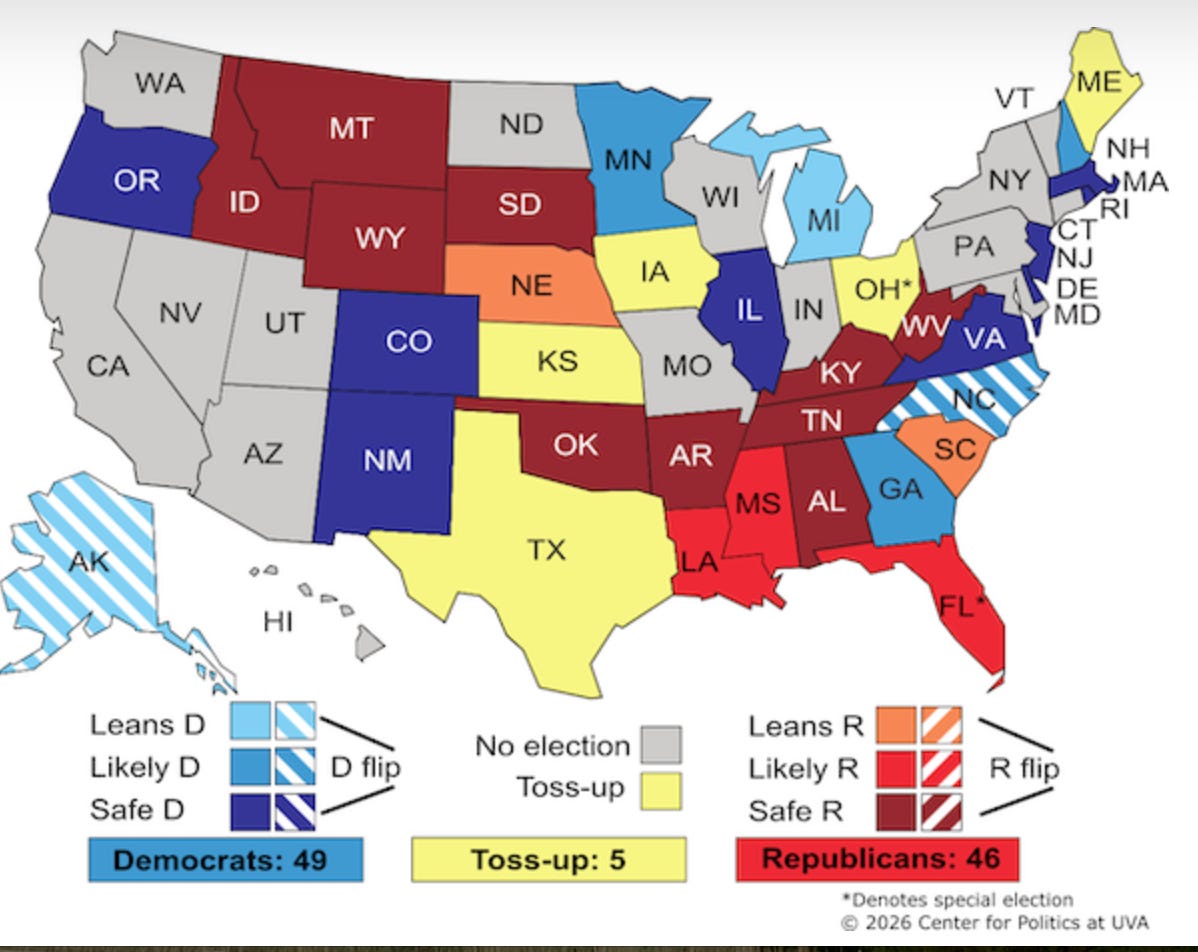
(Source: centerforpolitics.org/crystalball/2026-senate)
14. Today’s New York City Marathon begins long before the race itself.
News Items Science Editor Joanna Thompson training:

(Sources: joannathompson.work, instagram.com)
Quick Links: The Kremlin is refusing to compromise on its original maximalist demands from 2022. The US State Department approved the possible sale of 500 PAC-3 Patriot ballistic missile interceptors to Ukraine. Delivery will reportedly not occur for several years. Russia and Ukraine completed a remarkably successful humanitarian mission in occupied Kherson Oblast, as some Ukrainian civilians returned to Ukrainian-controlled territory. The Pentagon is buying drones by the thousands even as Chinese and Russian manufacturers crank them out by the millions. You’d think someone at DOD would pick up the phone and call Perry Boyle. Germany fails to meet gas storage target as winter approaches. Rating agency Fitch hits France with unscheduled outlook downgrade. Hundreds of thousands of protesters march across France for third week in a row. US vaccine policy creates ‘huge opportunity’ for Europe. Politico interviews Mark Carney. American bosses are desperately trying to de-MAGAfy. Charlie Cook: A unicorn election in red America. More than 7.5 million Texans voted early in 2026 election, matching 2018 pace. While Michigan Republicans circle the wagons around Mike Rogers, Democrats are firing rounds into a circular firing squad. Sen. Ricketts (R) leads (49%-43%) in Nebraska. DeepMind introduces Gemini 4 Carbon, our strongest model with state-of-the-art cybersecurity and long horizon capabilities. US tech stocks tumble as concerns over AI spending intensify. Housing theft happens almost 11 times a day in Mexico City.
No coverage of “Police secure Poland’s Constitutional Tribunal as protests erupt over court chief’s suspension” https://apnews.com/article/poland-european-union-justice-protests-police-tribunal-67eda2e3a151e00038d85a5e894a2a72 ?