

What follows (see below) was written by Paul Kedrosky, a fellow blogger back in the days when people blogged on Blogger.
Paul is an investor in private and public companies, as well as a writer and researcher. Originally trained as an engineer, he went on to do a Ph.D. at the University of Western Ontario in Canada, where he researched aspects of the economics of technology—specifically, the role of path dependency and network effects in risk & complexity.
Paul regularly speaks at private and public events across the U.S. and around the world, usually on topics related to risk finance, economics, the future of work, and artificial intelligence. He is currently a research fellow at MIT’s Institute for the Digital Economy, where he is studying artificial intelligence, economic disruption, and the future of work.
You can find his daily note at paulkedrosky.com. We urge you to subscribe. It’s always worth reading.
What Happened
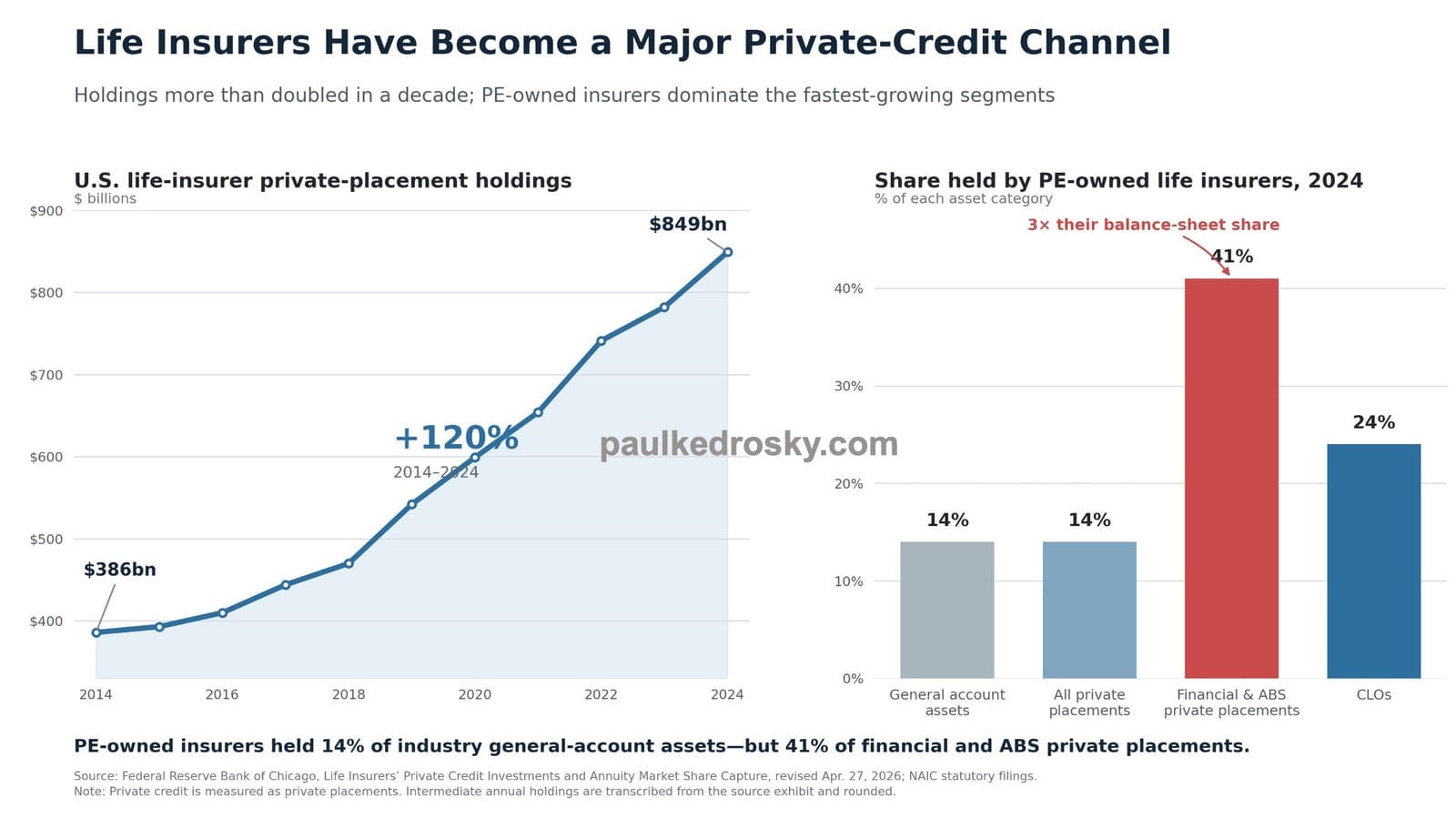
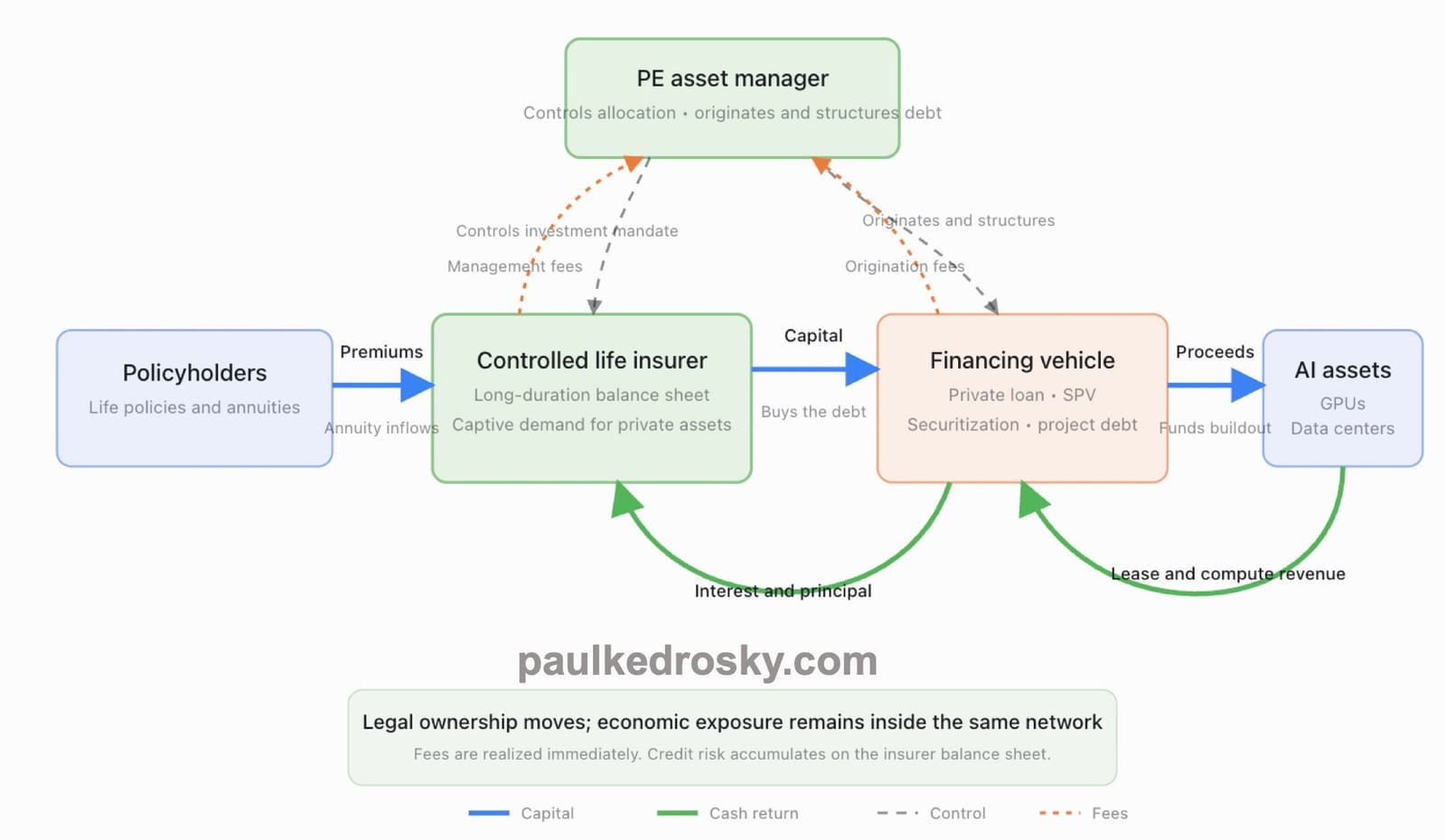
Private equity has increasingly taken control of life insurers, turning insurance premiums into permanent capital for private credit.
The asset manager can originate loans, collect fees and direct the insurer it controls to buy the resulting assets.
PE-controlled insurers now hold a disproportionate share of private placements, structured credit and other illiquid assets.
Private-credit investments held by US life insurers increased 21 percent in 2025, more than twice the growth of their overall assets. Source
Federal prosecutors and the SEC are investigating whether Mark Walter’s insurers concealed the extent of this circular financing.
Delaware Life initially reported about $1.4 billion of affiliated investments.
After receiving grand-jury subpoenas, it reclassified its holdings and disclosed $17.8 billion of private-credit investments whose returns depended predominantly on affiliated companies.
Total affiliated investments rose to roughly 40 percent of invested assets.
Delaware Life now plans to replace as much as $6.5 billion of related-party investments with unaffiliated assets. Source
This is happening just as AI infrastructure requires an unprecedented amount of private debt.
Nvidia has announced financing partnerships with Apollo, BlackRock, Blackstone, Brookfield, Goldman Sachs and KKR intended to mobilize more than $500 billion for AI infrastructure.
Apollo, Brookfield and KKR own major insurance businesses. Blackstone also manages large pools of insurance assets.
These firms therefore control both the machinery that originates AI-related debt and some of the largest pools capable of buying it. Source
The SEC has simultaneously made data-center debt easier to manufacture and distribute.
SEC staff ruled that certain data-center securitizations are not legally asset-backed securities because the issuing vehicle continues to own the facility after the debt is repaid.
Sponsors can therefore avoid important ABS requirements, including risk retention and much of the associated disclosure regime.
The structures generally have an anticipated repayment date of about five years, final maturities of 25 to 30 years and little recourse to the sponsor. Source
What It Means
The AI buildout has found a balance sheet large enough to support it.
Public bond markets cannot absorb all the required financing.
Life insurers hold enormous pools of long-duration capital and can buy private assets without daily market pricing.
They had been an obvious destination for the next wave of data-center debt, but that is now more fraught.
Syndication may create the appearance of risk distribution without meaningfully distributing the underlying risk.’
A loan can move through an originator, special-purpose vehicle, securitization, private-credit fund and insurer while remaining inside the same network.
There is regulatory arbitrage at both ends of the transaction.
Data-center sponsors can avoid ABS risk-retention and disclosure rules when issuing the debt.
Insurers can use private ratings, structured vehicles and favorable capital treatment when buying it.
Less sponsor capital goes in, less insurer capital may be held against it, and the leverage disappears into private structures.
The supposed duration match is weaker than it looks.
Life-insurance liabilities are long, and data-center buildings are also long-lived.
But the economically valuable parts of an AI facility are much shorter-lived: GPUs, customer contracts, model economics and demand forecasts.
A concrete shell lasting 30 years says little about its ability to service debt after two or even one technology cycle.
The Delaware Life unwind shows what happens when private marks meet outside buyers.
Walter’s insurers reportedly struggled to refinance some affiliated loans because prospective buyers rejected them or demanded substantial discounts.
Assets that looked acceptable inside a controlled system became harder to sell once an independent party had to price them.
Regulatory scrutiny could tighten AI credit before defaults begin.
Insurers facing higher capital charges, rating pressure or affiliated-asset limits may have to reduce private-credit holdings.
Asset managers would lose a captive source of demand, which would raise financing costs and force more AI projects back onto already over-stuffed public debt markets.
The eventual stress could first appear as an insurance-capital problem.
Falling private marks would reduce insurer surplus, trigger rating pressure and force asset sales.
Reduced insurer demand would then weaken new data-center financing and expose more optimistic valuations.
Because the assets are private, the adjustment could remain hidden until several firms need liquidity simultaneously.
The public backstop makes the structure especially troubling.
Failed life insurers are supported through state guaranty funds financed by assessments on surviving insurers.
In most U.S. states, those assessments are recoverable through premium-tax credits.
PE sponsors collect origination and management fees during the expansion, but competitors and taxpayers inherit the losses.
Related reading: