

Double, double, toil and trouble; Fire burn, and cauldron bubble. — William Shakespeare.
Will the AI financing cauldron bubble over? What kind of toil and trouble will follow? Earlier this week, Stephen Roach wrote a post that addressed this (general) subject. He’s given us permission to re-post it in its entirety.
By Stephen Roach.
Like most, I have been shocked at the trials and tribulations of Jensen Huang. We can debate endlessly the impacts of his sudden resignation and subsequent Phoenix-like resurrection as Nvidia’s leader. I have nothing to add to the lurid tales of how and why. But I want to take the opportunity to stress the case for an AI bubble, irrespective of the ultimate fate of Jensen Huang.
In my day-after-the-midterms piece in the Financial Times (“Morning in America, Twilight in the Markets”), I stressed that you don’t have to be a Luddite to worry about an AI bubble. The problem is not the technological breakthrough, itself, but the unrealistic value that markets are placing on expected financial returns of the coming revolution. I underscored four considerations that worried me the most:
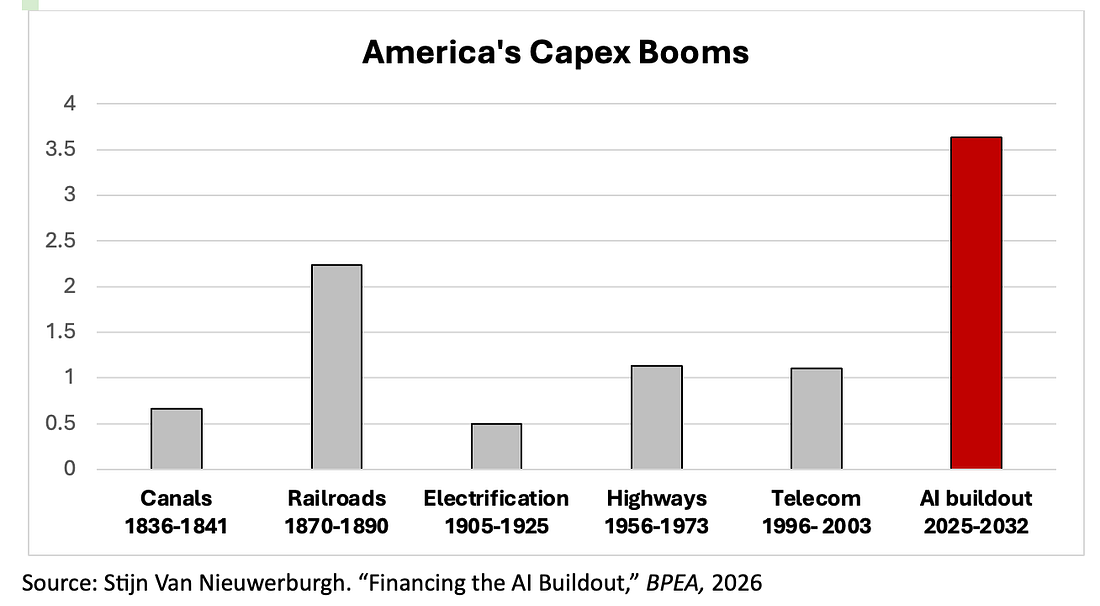
A data center build-out that a detailed tabulation of project data suggested would total some $10 trillion between now and 2032, or 3.6% of nominal GDP over this seven-year period (shown again in the chart below). Compared with 1.1% average share of GDP recorded during five earlier comparable revolutions — canals, railroads, electrification, highways, and telecoms — the coming AI capex boom is unrealistically off the charts. In other words, it won’t happen.
Cash flow positions of the leading hyperscalers — Alphabet, Amazon, Meta, Microsoft, and Oracle — are already shifting from positive to negative in 2026. The aggressive capex trajectory is likely to continue outrunning operating cash flow, suggesting that funding would have to shift from internally generated returns to increased issuance of debt — especially worrisome in a rising interest climate.
Alphabet is sending worrisome signs as the canary in this coal mine. Not only is its core Google search business being cannibalized by new AI-generated queries, but its net debt issuance is accelerating dramatically in response — in excess of $75 billion the first nine months of 2026 versus only a little more $11 billion over the comparable period of 2025.
AI concentration risk in the broader US equity markets is excessive by any standards of the past. Notwithstanding all the handwringing over the recent AI selloff, the Magnificent 7 equal-weighted grouping of AI stocks currently still accounts for about 33% of the total market cap of the S&P 500. By comparison, internet stocks accounted for only about 6% of the US equity market in February 2000.
These considerations have been largely unaltered by the recent drama at Nvidia. At the same time, a couple of other observations are worth noting that reinforce my view on the likely bursting of an AI bubble — drawing the massive $10 trillion AI data center bet into even sharper question.
First, the historic political Blue Wave that is still crashing on the United States underscores the downside of the AI capex trajectory. Apparently, 41 data center initiatives were on local ballots on November 3 that were aimed at restraining or restricting this massive projected surge of construction activity. Fully 40 of the 41 initiatives passed, underscoring the growing likelihood of a political backlash against the $10 trillion multiyear AI infrastructure buildout.
Second, I recently heard a fascinating presentation on AI by Nobel Laureate, Thomas Sargent, at a conference I attended in Shanghai. Like me, Professor Sargent, would be the first to concede that he is hardly an expert on the science of AI. Known for his pioneering work on rational expectations, Sargent drew on a fascinating new paper by Jessica A. and Jonathan Wachter to back out the AI-related productivity surge that would rationalize current equity market valuations. Similarly, he drew on the work of Hanno Lustig to back out the hyperscaler revenue trajectory implied by the $10 trillion capex build-out through 2032. In both cases, Sargent concluded that the productivity and earnings increments implied by the massive projected build out of data center construction activity were unrealistically large — not “rationalizable” in Tom Sargent’s view.
I hope for nothing but a happy life for Jensen Huang. But I urge you to separate his story, however scintillating it may seem, from the possible bursting of a massive AI bubble that could have potentially devastating consequences for the broad US equity market and for an increasingly AI-driven US economy. I share the view expressed in The Wall Street Journal that the consequences of an “AI bust” could be far worse than that which followed the dotcom bust of 2000.
Stephen Roach is a Senior Research Scholar of the Paul Tsai China Center at Yale Law School. He joined the Yale faculty in 2010 after 30 years at Morgan Stanley, mainly as the firm’s chief economist heading up a highly regarded global team followed by several years as the Hong Kong-based Chairman of Morgan Stanley Asia.
He was the first senior fellow to join the faculty of Yale University’s Jackson Institute of Global Affairs at its inception in 2010 and remained in that capacity until 2022; over that period, he was also a Senior Lecturer at Yale’s School of Management. A passionate teacher, he has drawn on his rich experience and developed popular new courses on Asia — notably “The Next China” and “The Lessons of Japan.” His prolific writings include the new book, ‘Accidental Conflict: America, China, and the Clash of False Narratives’ (2022), and ‘Unbalanced: The Codependency of America and China (2014)’.
Prior to joining Morgan Stanley in 1982, Roach served on the research staff of the Federal Reserve Board and was also a research fellow at the Brookings Institution. He holds a Ph.D. in economics from New York University.
If you’re not a subscriber to his Substack newsletter, sign up. His coverage of China is exceptional. His posts on economic matters and geopolitics are well-informed, well-considered and clearly written.