

“News Items is the first thing I read every morning”. — David Brooks.
1. Voyager 1 has been on an incredible journey that’s defied all expectations. And it’s hours away from reaching another huge milestone. The small car-sized spacecraft was the first human-made object to enter interstellar space, and for almost 50 years it’s been hurtling away from Earth at 61,100 kilometers (38,000 miles) per hour. Tomorrow, the spacecraft will officially reach 1 light-day away from Earth. Or to be precise, on 18 November 2026 at 10:16 UTC (2:16 AM PST), Voyager 1 will reach a distance of 25.9 billion kilometers from its home planet. That’s the same distance that light travels in a single day… and for Voyager 1, it will have taken the spacecraft more than 49 years. Along the way, it has delivered spectacular science, capturing enchanting views of Jupiter’s Great Red Spot and even an iconic portrait of our home planet as a “Pale Blue Dot” suspended in a sunbeam. (Sources: sciencealert.com, scientificamerican.com, Italics mine.)
2. The Pale Blue Dot:
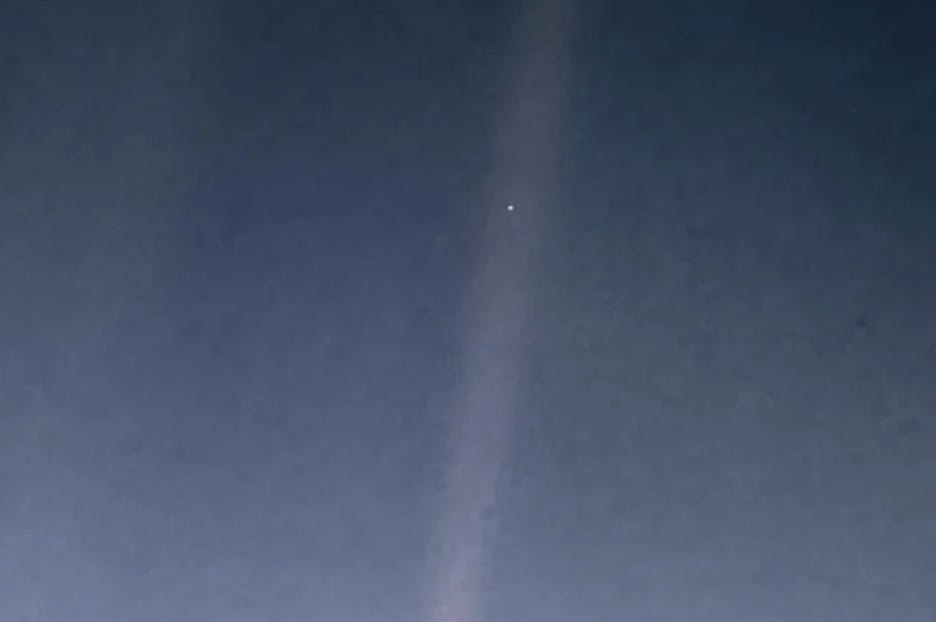
(Remastered image of Earth as a pale blue dot. The full image is here. Sources: scientificamerican.com, NASA and JPL-Caltech.)
3. Politico.eu:
Russian-speaking hackers built an AI agent that carried out what may be the first-ever fully-automated cyberattack, Google reported Monday.
The tech giant’s cyber threat intelligence division said it had spotted hackers using artificial intelligence to “fully automate vulnerability discovery and exploitation without a human in the loop for the first time.”
The development could mark an inflection point in the use of AI for cyberattacks, which has dominated headlines and worried policymakers since AI firm Anthropic released its specialized model Mythos in April.
Hackers, who used Russian in technical documentation identified by Google, set up a series of AI agents to “continuously compare pre- and post-patch code, identify vulnerabilities, and automatically develop exploits without human intervention,” Google said.
