

1. The Economist:
In the early days of large language models (LLMs), scientific aptitude was one of the benchmarks used to test how models surpassed their predecessors. But that test was no trickier than a high-school science quiz. Today’s best models, by contrast, are capable of handling postgraduate level questions, scoring a little over 50% on “humanity’s last exam”, a quiz spanning all domains designed to be as hard as a knowledge-based test can be (see chart below).
This rapid progress means AI labs are running out of data on which to test their models. The logical next step is for AI models to do novel research themselves. “Science and mathematics”, says Pushmeet Kohli, the head of Google DeepMind’s science team, “act as the playground, the grand challenges that we give to AI to drive innovation.”
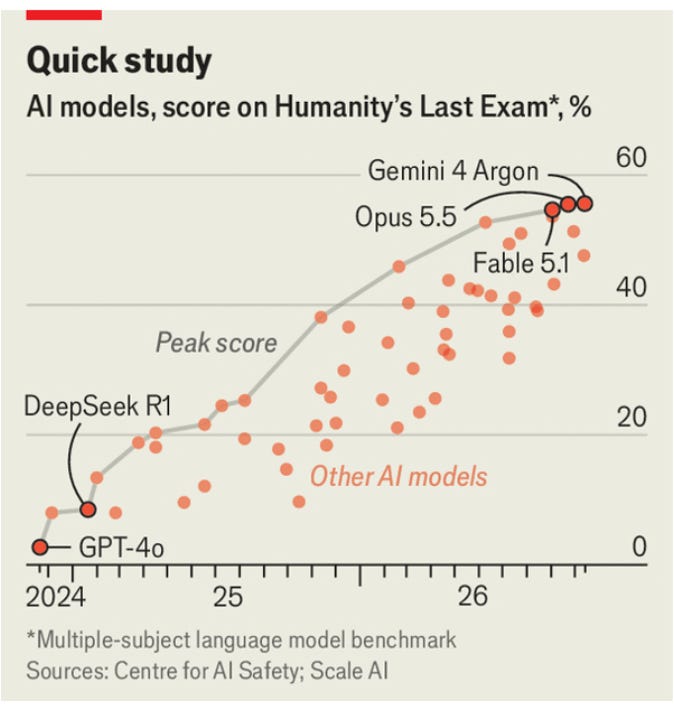
(Source: economist.com)
2. Financial Times:
Cracks are appearing in America’s debt-laden $10 trillion AI infrastructure boom as project delays, public backlash and shaky investor confidence bring a reckoning for the data center build-out underpinning the US economy.
A rush for computing power in recent years created what multiple people involved characterized as a “Wild West” market. They said money has flooded into brand-new companies and due diligence for new projects has been expedited, with AI labs such as Anthropic and OpenAI accepting higher short-term costs to move as fast as possible.
More than three years into the AI boom, these ambitious data center plans are running into reality. At least 47 large projects have been delayed, withdrawn or blocked in 2026, according to data shared by RegLayer, a regulatory intelligence company, which described it as a “conservative estimate” focused on the largest sites.
Analysts at Bernstein this month estimated only about 35 per cent of the planned US data center pipeline was credible. More than 1,000 communities across the US have tried to introduce moratoria or other restrictions on AI infrastructure this year, according to FT research. (Source: ft.com)
3. Mimi Jiang, The London Review of Books:
It is estimated that there are now 320 million gig workers in China, accounting for more than 40 per cent of urban employment. They include food delivery drivers, ride-hailing drivers, local freight drivers, domestic helpers, nannies, carers for the elderly and repair technicians. I wonder how long it will be before these jobs vanish in the face of competition from drones, driverless cars and robots. The second World Humanoid Robot Games in Beijing recently attracted a lot of attention. Clips of robots running and dancing in a ridiculous manner went viral, and the Tian Zhuo team’s robot ran the hundred metres in 9.39 seconds, beating the human world record of 9.58 seconds set by Usain Bolt in 2009. Opinions on the application of humanoid robots are divided. Some argue that a human shape is not the most effective mechanical solution for many household tasks and that there are better ways to design helpful machines. Others argue that most home facilities and appliances are designed for human height and movements, and that having lots of different robots doing different chores would be impractical. According to this year’s Humanoid Robot Industry Development Report, Chinese companies sold more than forty thousand humanoid robots in the first half of 2026, accounting for 97 per cent of the global market. Production costs have dropped by 70 per cent over the last three years and apparently commercial sales are just around the corner. (Source: lrb.co.uk)
