

1. Change:
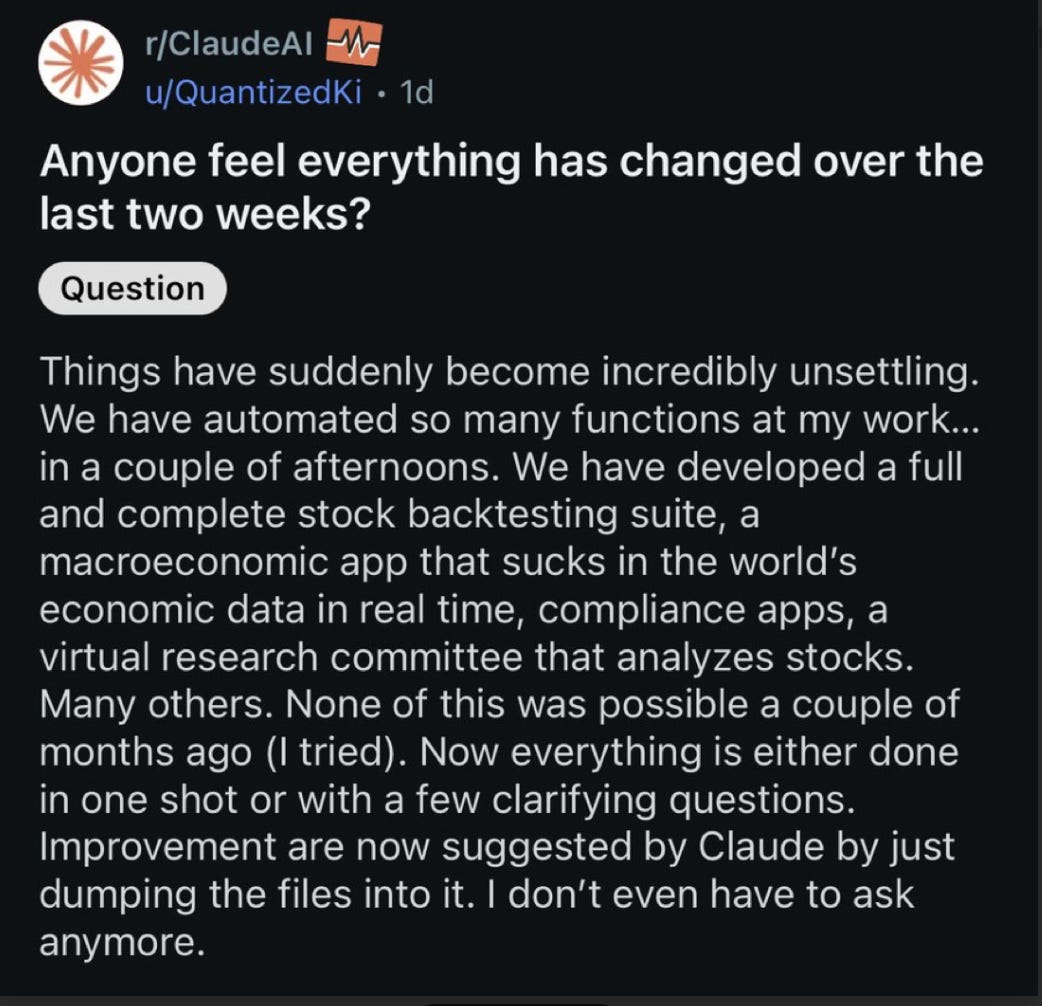
(Post via Bob Rice, Tangent Capital)
2. Email from a former top trader at Tudor Jones:
I think the argument that companies are stuck with the legacy IT systems because that are built in and integrated into their workflow could not be more wrong. This systems are usually shite and unwieldly - they are the problem. Sit down and logically tell the AI what you need and it will build you a far better system straight away - run it on the dev server to see if it works and then deploy it - being stuck with an old SAP or Oracle system is going to become a competitive disadvantage very quickly. (Source: anonymous. Italics mine.)
3. The company behind TikTok has developed an artificial-intelligence model that can turn a single text prompt into a high-quality video with a story line, scene changes and distinctive characters. The new AI video-creation model from Beijing-based ByteDance is generating buzz in China and a backlash in Hollywood over copyright issues. It shows how ByteDance, known for creating TikTok, is emerging as a rival to OpenAI and Google in the race to build tools for making AI movies and other video entertainment. “China’s visual models have been very, very competitive,” said Steve Long, a videogame developer in Helsinki who has participated in beta-testing programs for Google and ByteDance. (Source: wsj.com)
Data released this week offers a striking corrective to the narrative that AI has yet to have an impact on the US economy as a whole. While initial reports suggested a year of steady labour expansion in the US, the new figures reveal that total payroll growth was revised downward by approximately 403,000 jobs. Crucially, this downward revision occurred while real GDP remained robust, including a 3.7 per cent growth rate in the fourth quarter. This decoupling — maintaining high output with significantly lower labour input — is the hallmark of productivity growth.
My own updated analysis suggests a US productivity increase of roughly 2.7 per cent for 2025. This is a near doubling from the sluggish 1.4 per cent annual average that characterized the past decade. (Sources: economics.stanford.edu, ft.com. Mr. Brynjolfsson is the co-author of ‘The Second Machine Age’ with Andrew McAfee.)
5. Five years ago, Facebook shut down the facial recognition system for tagging people in photos on its social network, saying it wanted to find “the right balance” for a technology that raises privacy and legal concerns. Now it wants to bring facial recognition back. Meta, Facebook’s parent company, plans to add the feature to its smart glasses, which it makes with the owner of Ray-Ban and Oakley, as soon as this year, according to four people involved with the plans who were not authorized to speak publicly about confidential discussions. The feature, internally called “Name Tag,” would let wearers of smart glasses identify people and get information about them via Meta’s artificial intelligence assistant. (Source: nytimes.com)
6. The New York Times:
The Department of Homeland Security is expanding its efforts to identify Americans who oppose Immigration and Customs Enforcement by sending tech companies legal requests for the names, email addresses, telephone numbers and other identifying data behind social media accounts that track or criticize the agency.
In recent months, Google, Reddit, Discord and Meta, which owns Facebook and Instagram, have received hundreds of administrative subpoenas from the Department of Homeland Security, according to four government officials and tech employees privy to the requests. They spoke on the condition of anonymity because they were not authorized to speak publicly.
Google, Meta and Reddit complied with some of the requests, the government officials said. In the subpoenas, the department asked the companies for identifying details of accounts that do not have a real person’s name attached and that have criticized ICE or pointed to the locations of ICE agents. The New York Times saw two subpoenas that were sent to Meta over the last six months. (Source: nytimes.com)
7. A category of insurance risk that hardly existed a little over a decade ago has morphed into a meaningful source of losses for the industry. Claims tied to SRCC — strikes, riots and civil commotion — are emerging as a growing headache for insurers as episodes of unrest increasingly lead to the destruction of property in Western democracies. Howden Re estimates that insured losses related to SRCC soared from negligible levels in 2013 to more than $8 billion between 2020 and 2024. SRCC losses are prone to huge swings between years, with single events often changing the landscape significantly. After relatively few claims globally in 2025, Howden Re told Bloomberg it’s now expecting the US to see a clear increase in SRCC losses this year. (Source: bloomberg.com. Italics mine.)
8. When Iranians began protesting their government in late December, an ominous text message landed in some of their phones. Their “presence at illegal gatherings” had been noted and they were under “intelligence monitoring,” the Iranian authorities texted them. “It is advised that you refrain from attending such illegal gatherings, which are desired by the enemy.” Iran’s government most likely tracked the protesters through location data emitting from their phones, researchers later concluded. The move was part of a new phase by the authorities to combat opposition by tapping a vast digital surveillance infrastructure to track down dissenters who participated in the recent antigovernment demonstrations, according to human rights groups, researchers and documents. (Source: nytimes.com)
9. The U.S. military is preparing for the possibility of sustained, weeks-long operations against Iran if President Donald Trump orders an attack, two U.S. officials told Reuters, in what could become a far more serious conflict than previously seen between the countries. The disclosure by the officials, who spoke on condition of anonymity due to the sensitive nature of the planning, raises the stakes for the diplomacy underway between the United States and Iran. (Source: reuters.com)
10. The Japanese authorities on Friday night released a Chinese fishing boat captain after seizing his vessel and holding him for more than 30 hours, a move that had threatened to intensify the tensions that have simmered between Japan and China for months. The captain, Zheng Nianli, 47, had been sailing a Chinese trawler with 10 crew members on Thursday near Japan’s Goto Islands in the East China Sea. He was arrested and accused of ignoring a request from Japanese authorities for inspection after entering Japan’s exclusive economic zone. The crew remained aboard the boat. Yusuke Onozawa, an official with Japan’s fisheries agency, confirmed in a telephone interview that Mr. Zheng had been released shortly before 8 p.m. on Friday. He was expected to be reunited with his boat and crew, Mr. Onozawa said. (Sources: nytimes.com, jfa.maff.go.jp)
11. China will eliminate tariffs on all products from 53 African nations this spring, President Xi Jinping announced, a move aimed at cementing Beijing’s economic foothold in the Global South as the Trump administration ramps up trade barriers in Washington. In a message sent Saturday to the African Union Summit in Addis Ababa, Xi said the blanket zero-tariff policy would take effect May 1 for all African countries that have diplomatic relations with China. The initiative expands on previous waivers that applied only to the continent’s least-developed economies. (Source: caixinglobal.com)
12. Secretary of State Marco Rubio said Europe’s fate is intertwined with the US while faulting the continent for what he said was a drift away from their shared Western values. The double-edged message offered some reassurance to allied leaders gathered at the Munich Security Conference but did little to temper their push for more independence from Washington. “We want Europe to prosper because we’re interconnected in so many different ways, and because our alliance is so critical,” Rubio told Bloomberg News Editor-in-Chief John Micklethwait on the sidelines of the conference on Saturday. “But it has to be an alliance of allies that are capable and willing to fight for who they are and what’s important.” (Source: bloomberg.com)
13. In much of Canada, President Trump’s provocations like making the country a 51st state are deeply unpopular. In this conservative, oil-rich province, Trump presents an opportunity. Alberta is poised to hold a referendum on seceding from Canada later this year, and supporters of independence credit Trump’s disruptive energy for adding fuel to their movement. Alberta secessionists view Trump as a powerful ally in their quest to rattle Canada’s liberal politics and supercharge oil production—and no obstacle to their independence, even if statehood is unlikely. Albertan independence is a remote but chilling prospect for Canada. The western province is a resources powerhouse that holds most of Canada’s crude oil. Only Saudi Arabia and Venezuela have bigger reserves of crude. (Source: wsj.com)
14. “Remote” is the right word. Three months remain until a petition’s deadline on Alberta separation, but a recent poll shows support for the province leaving Canada appears not to have budged much. New polling conducted last week by the Angus Reid Institute of 979 Albertans found just 29 per cent would vote to separate from Canada. Of that group, only eight per cent — 80 people — said they would definitely vote to leave, while 21 per cent leaned that way. Meanwhile, 57 per cent said they’d definitely vote to stay, while 81 people, or eight per cent, said they’re leaning towards staying. (Sources: 338canada.ca, globalnews.ca. Italics mine.)
15. The seven Western states that rely on water from the Colorado River have run out of time for compromise to share its dwindling supplies, just as new projections show reservoir levels could sink to a critical low by the end of this year. Interior Secretary Doug Burgum said on Saturday that the states had missed a Valentine’s Day deadline to reach consensus on a plan to guide use of the river over the coming decades. He said the federal Bureau of Reclamation would instead soon impose its own plan. (Source: nytimes.com)
Quick Links: What a speech reveals about Trump’s plans for nuclear weapons. Nuke-talk is heating up among Europeans in Munich. Trump says regime change ‘the best thing that could happen’ in Iran. US military reports a series of airstrikes against Islamic State targets in Syria. Israel’s wartime brain drain raises fears of permanent exodus. The Department of Homeland Security is a mess. ICE reveals $38 billion plan for immigrant mega-jails. US Justice Department sues Harvard over admissions records access. Russian dissident Alexei Navalny was almost certainly killed by a poison derived from a rare frog toxin. Goldman Sachs general counsel Kathy Ruemmler resigns. Great Swami advises followers: Bet on the sister, even though she’s up against the most dangerous 13-year-old in the world.
Olympics Tonight: Ski jumpers take off from a 136-meter hill for the women’s individual large hill event. (7pm ET. USA Network).